

By Beth David, Editor
Jessica Fidalgo, a Fairhaven resident, Planning Board member, and social justice activist, won the essay contest open to all students of Bristol Community College.
The prompt for this year’s contest was: “How are Dr King’s views and work relevant to us today? In what ways can citizens today affect their own communities and elicit change?”
James Mesalon won second place, Geraldine Fequiere received third place. First place winner received $250, second, $150, third, $100.
As the first place winner, Ms. Fidalgo was allowed to read her essay at the breakfast.
The following is the shortened version she read at the breakfast on 1/19/26. The unabridged version is on her substack at https://tinyurl.com/hdkwawds
The event featured a keynote address by Dr. Sean Edmund Rogers, Dean of the University of Rhode Island School of Business.
Visit www.BristolCC.edu/MLK to learn more about the event.
—————-
-
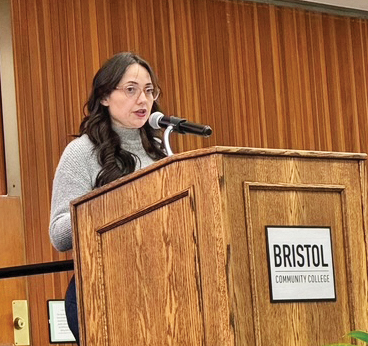
- Fairhaven resident, Jessica Fidalgo, reads an abridged version of her winning essay at the annual MLK Community Breakfast at Bristol Community College on 1/19/26. Photo courtesy of Joyce Brennan.
By Jessica Fidalgo
Dr. Martin Luther King Jr.’s legacy is often remembered through the big moments the marches, speeches, and sweeping national change, but one of the most powerful parts of his message is something quieter: the belief that ordinary people, in ordinary roles, have extraordinary power to shape the world around them.
In 1967, speaking to students in Philadelphia, Dr. King told them that if life called them to be a street sweeper, they should sweep streets “like Michelangelo painted pictures.”
I’ve always loved this quote because it reminds us that dignity, leadership, and impact aren’t reserved for people with titles. They live in the everyday ways we choose to show up for our communities.
That message feels especially relevant here today in a place dedicated to learning, opportunity, and public life. Through my studies in government, leadership, and sociology, and through my involvement in my community, I’ve learned how deeply our lives are shaped by local decisions. Often, those decisions aren’t made in grand settings. They’re made in classrooms, meeting rooms, and community spaces by people who simply chose to participate.
It’s one thing to read about policy or economics in a textbook. It’s another to see how a single decision can affect a neighborhood, access to resources, or a community’s sense of belonging. When Dr. King spoke about doing work with excellence and purpose, he was pointing to a truth I’ve come to understand firsthand: leadership begins with taking responsibility for something that matters.
In my writing, I often use the word ownership. Ownership doesn’t require a title or position. It shows up in small, consistent acts of care by the volunteer who arrives early to set up chairs, the student who asks a thoughtful question, the neighbor who looks out for someone else. These actions may seem small, but they are exactly the kind of everyday commitment Dr. King believed could transform society.
Serving in my community has shown me that real change rarely begins with sweeping laws or dramatic moments. More often, it starts when someone notices a problem, a gap, or an injustice and decides not to look away. As Dr. King reminded us, neutrality is not neutral. Each of us plays a role in either maintaining the systems around us or helping shape them into something better.
-
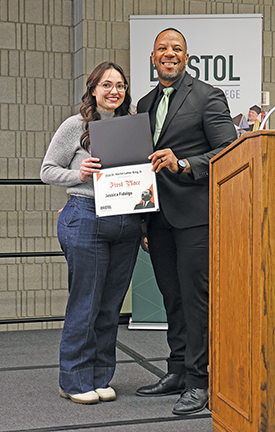
- Fairhaven resident, Jessica Fidalgo receives her first place certificate from Dr. Dariel “DT” Henry, the chair of the Martin Luther King Committee/Director of TRiO, at the annual MLK Community Breakfast at Bristol Community College on 1/19/26, when Ms. Fidalgo read her winning essay. Photo courtesy of Kevin Spirlet.
For a long time, I didn’t see myself as a leader. I thought of what I was doing as simply caring, as just being a regular person trying to help. But over time, I’ve seen how much those small actions matter. I’ve watched a single question change the tone of a meeting. I’ve seen small collaborations grow into meaningful traditions. I’ve seen people step in for one another in ways that quietly shape the culture of an entire community.
I often think about the moment citizenship stopped feeling like a status and started feeling like a verb for me. It wasn’t dramatic. There was no big announcement. It happened in a meeting, during a discussion that would shape our community for years. I wasn’t an expert, and I wasn’t sure I even belonged in the room. But I asked a question. Then I asked another. That ordinary decision to refuse silence changed the direction of my civic life.
That was the moment I realized local government, and civic life more broadly, wasn’t something happening around me. It was something I was part of. That shift from “someone should fix this to maybe I can help” is the same shift Dr. King urged in that speech to those students.
Dr. King reminded us that the power to build a more just, compassionate, and responsive community doesn’t belong only to those in high office or leading national movements. It belongs to ordinary people willing to act with care, purpose, and courage in the places they call home.
King taught that history bends when people push. My experience has taught me that while one person can begin that push, the bending and ultimately transforming systems takes all of us. And that work begins the moment each of us decides to take ownership of our communities, and to treat citizenship not as a title we hold, but as the verb it truly is.
•••
Click here to download the 1/22/26 issue: 01-22-26 Snow
Support local journalism, donate to the Neighb News with PayPal